Criminal vs Civil Law: Know the Difference

Civil and Criminal Law Compered
What is Crime ?
Harmful act or omission against the public . Which the state wishes to prevent and which , upon conviction is punishable by fine, imprisonment, and death. No conduct constitutes a crime unless it is declared criminal in the law of the country. Some crimes (such as theft or criminal damage) may also be civil wrongs (torts) for which the victim (s) may claim damage in compensation.
Differences Between Criminal and Civil Law
Issue
Civil Law
Criminal Law
Area of Concern.
Rights and duties between individuals
Offenses against society as a whole.
Wrongful act.
Harm to a person
Violation of a statue that probhits some type of activity.
Party who brings.
Person who suffered harm.
The State.
Standard of proof.
Preponderance of the evidance.
Beyond a reasonable doubt.
Remedy.
Damages to compensate for the harm.
Punishment ( fine or imprisonment).
Strict Liability
A number of offence are considered under strict liability ,even if they are committed without . The presence of a guilty mind. Actus non facit reum nisi sit rea (has a couple of exception).
- Criminal libel.
- Public nuisance.
- Contempt of court.
- Abduction / Kindnapping.
- Bigamy.
- Waging war.
- Sexual Harassment.
- Rape.
- Selling of obsence books.
- Essential commodities Act, 1955.
- Motor Vechicles Act, 1988.
Element of a Crime
There are 2 essentials elements required for criminal liability.
- Actus Reaus (Criminal Act).
- Mens Rea (Guilty Mind or Criminal Intent).
- Purpose.
- Knowleage.
- Negligence.
- Recklessness.
Exception - "Strict Liability Law" - can be guilty w/o mens rea. Usually involve endangering the public in some way.
Stages of a Crime under IPC
- Intention.
- Preparation.
- Attempt.
- Commission.
When the offences is regarded as a serious offence, preparation to commit offence is penalised under the Indian Penal Code. A few of them are mentioned below;
- Warfare perparation against the government (Section 122 of IPC ).
- Preparing coins or government stamps for counterfeiting (Section 233,235 and 257 of IPC).
- Having counterfiet money., fraudulent documents, or fake weight and measurment (Section 242,243,259,266 of IPC ).
- Making plans to commit dacoity (Section 399 of IPC).
Difference Between Preparation and Attempt
Preparation
Attempt
It means to arrange means or measure necessary for the commission of crime.
It is the direct movement towards the commission of crime after necessary preparation has been made.
Mens rea is not visible.
Mens rea is visible.
Generally , no punishment.
Always punishable.
Previous stage.
Subsequent stage.
Opportunity to defend.
No. opportunity to defend.
Scope of Section 511
- Attempt to commit offences in general punishable.
- Attempts to commit on offence punishable with imprisonment.
- Offence should have done some act towards commission of the main offence.
- Such an attempt is not expressly covered as penal provision.
- Supreme court on Section 511
Conclusion
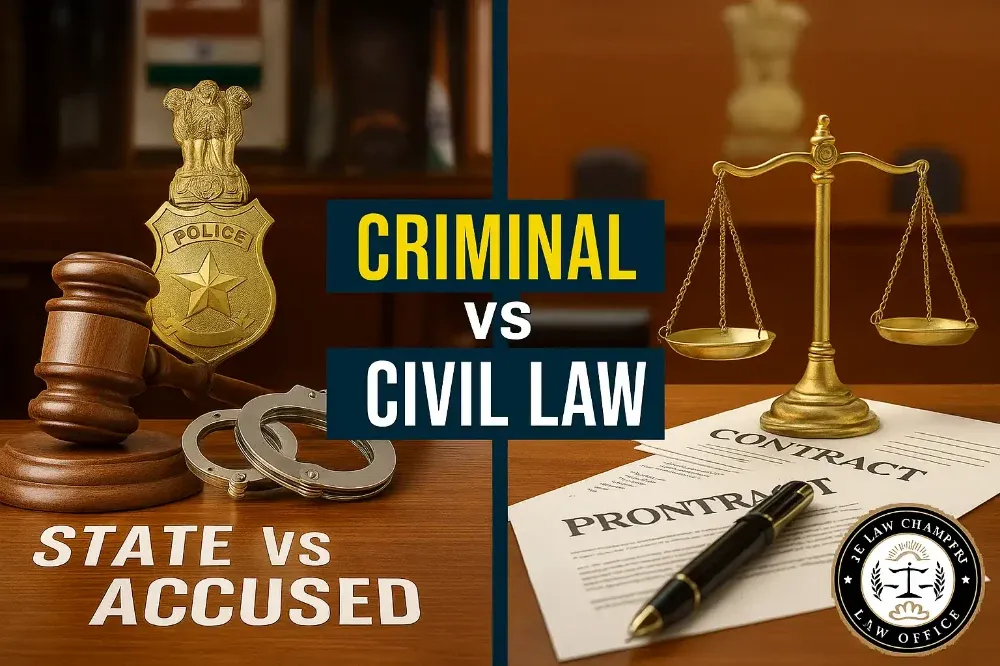
In conclusion, criminal law and civil law serve different purposes in the legal system. Criminal law deals with offences against society and aims to punish offenders, while civil law focuses on resolving disputes between individuals and providing remedies. Together, both branches of law help maintain justice, protect rights, and ensure social order.