The Sikh Period in Jammu & Kashmir (1799- 1947)
Sikh Ruler in Jammu and Kashmir (1799- 1947)
Introduction
The Sikh Rule in Jammu and Kashmir (1799- 1947) is an important period in the history of the region. It began when Maharaja Ranjit Singh defeated the Afghan rulers and took control of Kashmir. During this time, Kashmir was governed by Sikh administrators, which brought changes in administration, economy, and society. This period ended in 1846, leading to the rise of Dogra rule under Maharaja Gulab Singh.
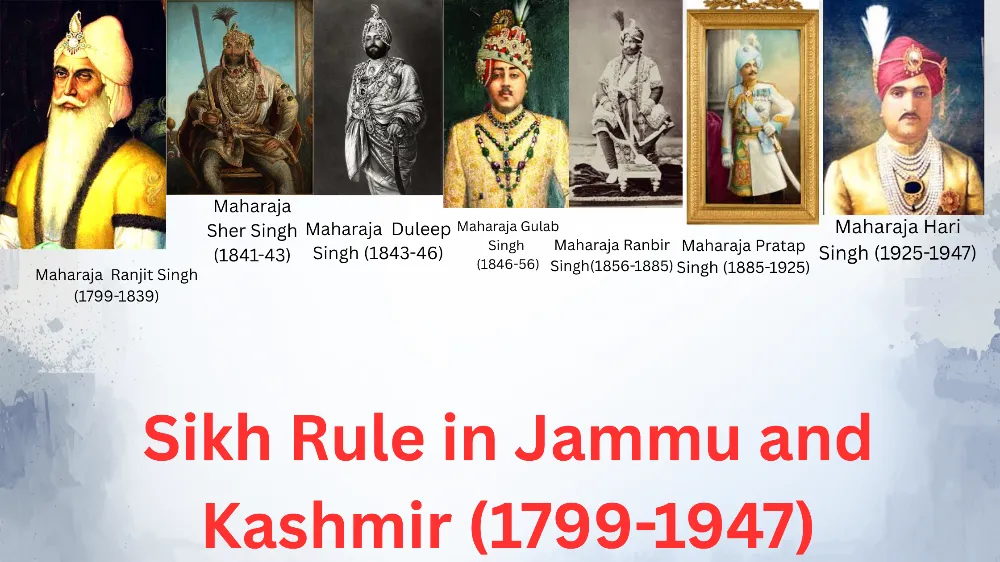
This is 7 Ruler in Kashmir
- Maharaja Ranjit Singh.
- Maharaja Sher Singh.
- Maharaja Duleep Singh.
- Maharaja Gulab Singh.
- Maharaja Ranbir Singh.
- Maharaja Pratap Singh.
- Maharaja Hari Singh.
1. Maharaja Ranjit Singh (1799- 1839)
- Birth of Ranjit Singh - Nov- 2, 1780.
- Son of Mahan Singh.
- (Leader Of Sukharchakiya Misl ).
- Mahan Singh died when Ranjt singh was 12 years old.
- Raised by mother Raj Kaur.
- In 1799 Ranjit Sigh accquired Lahore from Zaman Shah, major Conquest by Ranjit Singh.
- In 1819 , Kashmir become part of Lahore Darbar and Remained part for 27 years.
- Inn Diwan Moti Ram was the First Sikh Governer of Kashmir.
- Administration of the city was entrested to an official called Kotwal.
- Being Appointed Thanedar to maintain toward and order.
- Most important official was called wazir.
- UDHO was appointed as wazir by him.
- Kulpurohit was the religious advisor of Maharaja.
- Mian Singh was the most able sikh governer popularely called 'colonel' .
- In 1832, Victor Jacqcmount French part of visited Kashmir to carry out "Botanical Survey."
- In 1830, he coated gold foil on Harmandir Saheb hence called Golden Temple.
- On April, 25 1809, Maharaja signed Teraty of Amritsar
- In 1838 Signed Treaty of Triparited.
- Ranjit Singh died in 1839.
- Karak Singh (1839)
Prince Nav Nihal Singh (1839-40)
Chand Kaur (1840)
- Wife of Kharak Singh and mother of Nav Nihal Singh
- Only for 2 and a half months
- Acted as regent an behalf of unborn child of Nav Nihal Singh
2. Sher Singh (1841- 43)
- Son of Ranjit Singh
- Murderd in 1843
- Before becoming Maharaja, Sher Singh was a capable general. He notably defeated Sayyid Ahmad Barelvi at the Battle of Balakot in 1831 and led forces that captured Peshawar from the Afghans in 1834.
- He was a lover of luxury and the arts, often depicted in portraits wearing the Koh-i-Noor diamond on his arm. He patronised European artists like August Schoefft, who painted famous scenes of his court.
- His reign saw the successful conquest of the Ladakh valley and a subsequent peace treaty with Tibet in 1842.
3. Maharaja Duleep Singh (1843- 46)
- Proclimed as Maharaja with Rani Jind as regent and Hira Singh Dogra as Wazir.
- Hira Singh Dogra Mudered in 1844.
- New Wazir Jawar Singh (Brother of Rani Singh ) death in 1845He.
- Lal Singh, New Wazir .
- Teja Singh, Commandar of the force.
- Last Sikh Ruler Govener Shaikh Imman -ud- din 1845.
- Treaty of Lahore March 8, 1846.
- Duleep Singh- Sir Herney Hardiegen - 1
4. Maharaja Gulab Singh (1846- 56)
- Born on 17th October 1792.
- Founder of Dogra Dynasty in Jammu and Kashmir.
- Son of Kishore Singh.
- 1817 General Zorawar Singh.
- Gulab Singh - 1) Dhian Singh 2) Suchet Singh
- In 1828, Mian Dhain Singh received the Tittle of Raja of Bhimber. He was the longest serving Diwan 25 years , mudered in 1843.
- Battle of Jammu / Gumat 1808.
- In 1821, Caputred from Aghar Khan and placed Rahim- ul - Khan as the new Raja by Ranjit Singh.
- Zorawar Singh helped Gulab Singh.
- Krishtwar was annexed by Gulab Singh.
- March 9, 1846, Treaty of Lahore.
- Gulab Singh first Maharaja of Jammu and Kashmir Second largest primely state Bristish.
- Crime was support during his regin, captured leader of Lawans.
- He drove out Khathas and Bombas out of the Valley.
- He under took to reforms System.
- He organised Revenue and Police administration
- He organised the Shawl industry.
- Founded the Dharmarth Trust.
- Reorganistion of administration reformed policies and reneve administration by reorganising into 4 wizards and appointed trusted offices in Dey dapartments account,Shawl departament etc.
- Started the constrution of Ragunath Temple in 1851.
- Reasi fort was first renovation by Maharaja Gulab Singh in 1817 and was completed in 1891.
- Gulab Singh - 1) Mian Udam Singh (Uttan Singh) 2) Mian Randhir Singh (Sohan Singh) 3) Mian Ranbir Singh ( Rhena Singh ).
5. Maharaja Ranbir Singh (1856- 1885)
- Completed the Construction of Ragunath Temple in 1857.
- Scholar of Sanskrit and Persian language.
- Loved Speaking Pashto Launguage.
- Established Sanskrit Pathshala in the complex of Ragunath Temple.
- Donated 1,00,000 rupee to set up Punjab university at Lahore.
- Set up Maktabs and Pathsalas in Jammu, Srinagar and other town.
- Improved collection of land reneve and fixed land reneve at the fixed amount.
- Reforms inadministration three main department.
- a) Revenue. b) Civil. C) Military.
- Judicial system was re-organised and Ranbir Panal code was set up.
- Adalat - ul- Saddar (Chief court ) was established in Jammu and Kashmir.
- In 1877 Adalat - ul - Aliya ( High court ) was established and power were defined.
- Abolished export duty on Shawls, Improved silk making.
- Telepgraph and Postal Service were instiutied.
- Princley states of Hunza and Nagar started tribute.
6. Maharaja Pratap Singh (1885 - 1925)
- Abolition of beggar.
- Chitral was over taken in 1891.
- Sir Walter Lawrance started new land revenue settlement (1889-1895).
- Banihal Cart Road was started and got completed in 1915. It was Maharaja Private road later opened to public use in 1922.
- Telegram lines were extended to all important towns and telephone connection between Jammu and Kashmir wall established.
- Improvement was made in Jehlum Valley Cart road.
- Tourism increased during his reign.
- Hydroelectric project at Mohra was Commissioned in 1905. It was the first state hydroelectric project.
- Mission school was started by Rev-Doxey, English education was introduced in goverment school and later on introduced in Jammu Prince of wales college.
- Shri Pratap College in 1905 in Srinagar was established and contruction of Shri Pratap Singh Museum in Srinagar in 1898.
- State established forest department in 1891.
- Vaccination on extensive scle was introduced in 1894.
- Silk Industry was set up in Srinagar in 1907.
- Development in the field of irrigation longest and important being Ranbir canal in Jammu (1903-08).
- UJH Canal started 1915, finished in 1923.
7. Maharaja Hari Singh (1925-1947)
- Grandson of Maharaja Gulab Singh.
- Son of Raja Amar Singh.
- Born Year- 23rd Sept 1895.
- Commander in cheif of state force 1915.
- Senior member of then state 1915 council 1922.
- On occasion of Raj Tilak Proclaimed.
- Justice as his religion announced establishment of 144 new schools (1926-27)
- Introduced rules under which children were forces to receive moden education Jabri School.
- State Subject Defination, 1927.
- 1934, Praja sabha - 1st legnlatual of Princely State of Jammu and Kashmir.
- Agriculture Relief Regulation - 1926.
- Land Alination Regulation - 1933.
- Kashmir Valley Panchayat Regulation - 1935.
- Dhara Devi Memorial Fund.
- Infant Marriage Regulation - 1928
- Widow Remarriage and Property Act - 1932.
- Suppressed Prostitution and Traffic.
- Rum Rasam - 1937,1939.
- 1932 - All Jammu and Kashmir Mulism conferance founder Chaudary Ghulam Abbas.
- 1939- National Conference.
Conclusion
The history of Kashmir has been significantly shaped by these seven rulers—Maharaja Ranjit Singh, Maharaja Sher Singh, Maharaja Duleep Singh, Maharaja Gulab Singh, Maharaja Ranbir Singh, Maharaja Pratap Singh, and Maharaja Hari Singh. Each of them played an important role in shaping the political, social, and economic structure of the region.
From the Sikh rule to the Dogra dynasty, Kashmir experienced major transitions that influenced its identity and development. Their leadership, policies, and governance continue to hold historical importance even today.
In conclusion, the combined contributions of these rulers have left a lasting legacy, making Kashmir a region rich in history and cultural heritage.