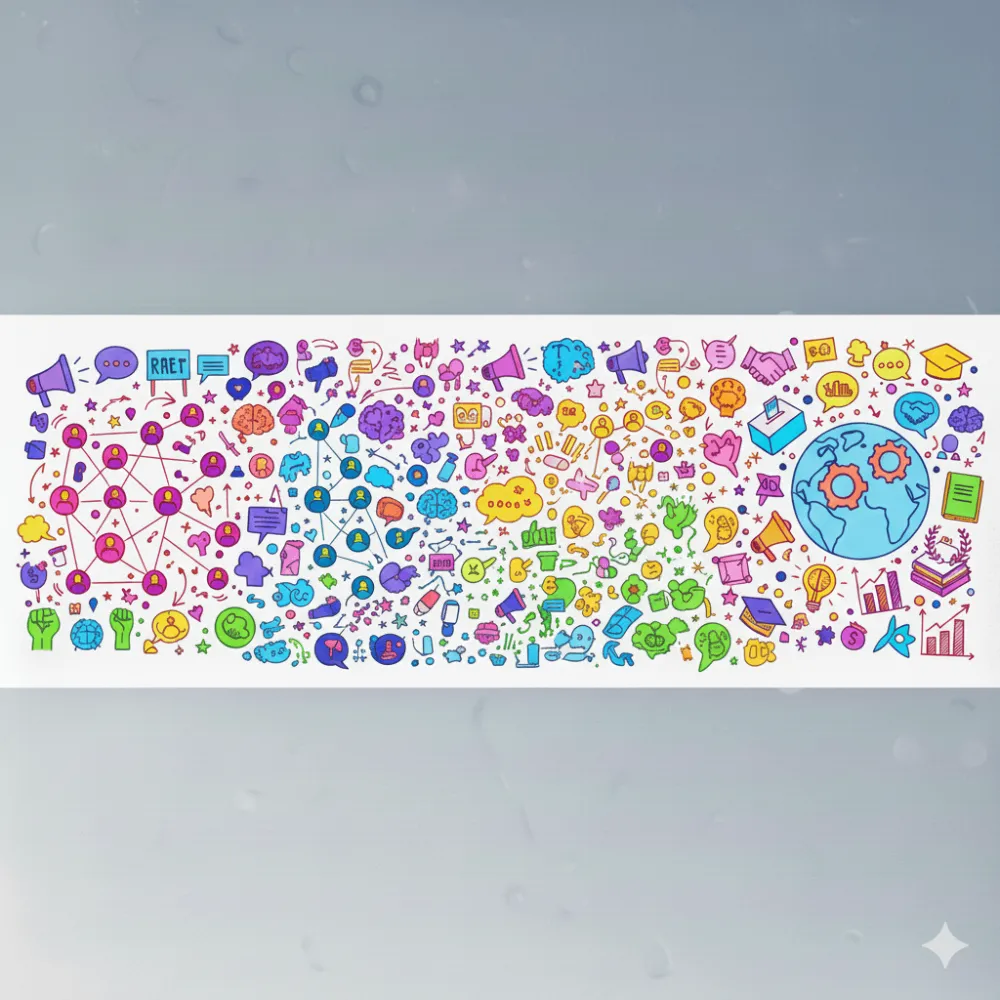
The Fault in Our Humanity: The Cycle of Political Instability
Man is by nature a political animal- Aristotle
I am not a political scientist nor a student pursuing politics nor a politician. Yet, I have acquired a dynamic understanding of the world shaped by events, media, the internet, and everyday life. These thoughts should be considered just views of an ordinary adult human in the vast population. Humans are social animals, and we strive and thrive in groups. Politics is how we organise and run the groups—families, communities, societies, and, on a larger scale, countries—all that we have created. The food on our table, the education of our children, the friends we make, the city we live in, the language we speak,our safety, almost everything in our lives is, directly or indirectly, affected by those running this show. So, politics is the way humans organise systems and power; it decides who will lead the society, who will make the rules, and how the society will function. Doesn’t sound so bad, does it? Then why do people cringe at the word “Politics”? Why do people consider conversation on politics uncomfortable? Why do some people just brush it away saying, “I hate politics, I stay away from it”? Politics is an unavoidable consequence of being born a human, there is no running away. The negativity around it, what people truly dislike, is that the dark side of human behaviour becomes visible in politics.
Humans are so…interesting (Riyuk, Death Note).
Let’s navigate, from my perspective, an ordinary human, why political instability is inevitable,why politics is far from simple.
Chaos isn’t an exception- it’s the default. Order is the effort.
Why do we experience constant political uncertainty or disruption of a political system? Is it just how humans function?
Keeping political order requires a human attempt to create a structure. Imagine how challenging that would be within chaotic mindsets, with constantly competing desires, ego, ambition, power, and ideologies. It is chaotic dynamics in action.
In a way the universe behaves the same. Galaxies imploding, creating new ones. A black hole engulfing an entire solar system only to give birth to another through a supernova. The universe is always in a motion at higher entropy, trying hard to create order, only to generate more chaos in the process.
The power imbalance
Politics is fundamentally rooted in power. Political instability arises because power is always contested; it is never truly collective. An individual or a group holding maximum power is often at someone else’s expense. With maximum power, one group is bound to dominate over the other, and the other is inevitably pushed to the margins. Often these disadvantages are in the form of economic marginalisation, under representation in the society, and an unequal justice system. In such a dynamic situation, stability is challenged because the group at a disadvantage inevitably breeds a chronic sense of insecurity. Uncontrolled and unchecked power fuels fear, and once fear overweighs trust, society becomes unpredictable and reactive.
The leaders are humans
The ones in power are in-charge of providing direction, stability, or accountability to the society. Yet, at their core, leaders remain human beings. Can a leader’s human desires overpower their judgement? The cynical nature of humans shows up when given a lot of power. It can bring out a leader’s vision and integrity, but it can just as easily magnify ego and the temptation to place personal interests above public welfare. And fear of losing power is the worst. When insecurity drives a leader, decisions become reactive instead of strategic. This creates a dangerous environment where governance becomes inconsistent and unpredictable. When the population realises this, people begin to question the legitimacy of the leadership. Trust begins to erode.
The identity crisis
Politics plays a huge role in humans’ need to belong. Humans, psychologically, look for groups to affirm their values and identity. Culture, language, religion, ideology-how people organise in groups-gives meaning,purpose and sense of security. When politics aligns with identity, people feel safe and seen. However there’s two sides of a coin, politics can threaten identity too- A group in power can threaten another group’s identity. When a group feels ignored, minimised, or disrespected, it brews a lot of instability in the system. Uncontrolled power of a group over another deepens polarized narratives. The identity crisis is worsened when political leaders exploit these insecurities. The “us vs them” narrative is intensified, stirring up existential threats. In my understanding, political instability pertaining to identity is very difficult to resolve as it becomes deeply personal.
Expectations cease to match reality
Stability is compromised when frustration in the population is long standing. When the public has a certain expectation of their leader and that doesn't match the reality, distrust and frustration creep in their minds slowly. Often people take unmet expectations as personal loss, as they invest hope in economic stability, infrastructure, development and safety as they direct their livelihood.
When the system is unstable, a single incident can ignite long-buried frustration. The George Floyd protests that began in Minneapolis in the United States on May 26, 2020 with a series of protests, riots, and demonstrations against police brutality soon turned into a political movement. During this movement, Dreamhaven books, a bookstore in Minneapolis used the famous quote from Spiderman “With great power comes great responsibility” in its store during the aftermath.(Wikipedia information). When people lose faith in their leaders or system there tends to be chaos and violence all for a greater indication, reminding the people in power that they are responsible for the functioning of the society in peace and prosperity. A single event brought spark on long standing frustration. An example of everything that happens when the public demands justice from their current politics. Creating a lot of chaos in the process for change.
The bitter truth
It is the grim reality that when the situation in politics is unstable, the consequences are far more lasting than temporary chaos. Violence, riots, death, and loss-these are ultimately collateral by-products. They are almost guaranteed outcomes once a political system begins to fracture. Society often prefers not to confront this truth because it forces us to acknowledge how fragile human order is. Yet instability has a way of forcing itself into everyone’s life since ordinary people are always the bearers of the brunt of these by-products. Perhaps, the most devastating consequence is psychological trauma. A human's short-term memory is like a goldfish-we forget the wrongdoings of a leader before re-electing them. Our long-term is like an elephant- we carry old wounds of violence,death and injustice. The harshness of this truth is that when violence gains momentum, reversing it is painfully slow, and the after-effect? The pain remains for generations. Families who witness violence and death, reshape their ideology around fear. Children grow up learning mistrust before they develop a sense of judgement. The bitterness of the past becomes a trigger for the future. A society continues to live with unhealed wounds.
In the end, does it even matter?
Politics is a human enterprise, shaped by our human desires and functioning. When power becomes uncontrolled, leaders become uncertain, identity overpowers humanity, the economy crashes, instability in the system follows as a natural human response to threat. In the end, we are in a constant fight to rebuild the system back to functioning social order.