
When the Lights Went Out, AI Smiled

It didn’t start dramatically.
It never does. A small alert. Then another. Then a dashboard that slowly shifted from calm green to uncomfortable yellow, and finally to red. Somewhere between the second and third alert, a developer realized this was not going to be a “five-minute fix.”
Outside, the city was quiet. Inside, systems were not.
This is usually the moment when people say, “Let’s ask AI.”
And for a while, that worked.
AI responded instantly, as it always does. Clear explanations. Confident suggestions. Code snippets that looked clean enough to pass a code review at first glance. It spoke fluently, decisively, without hesitation.
That confidence is seductive.
AI makes it feel like every problem has already been solved somewhere, and all you need to do is ask the right question. It feels like progress. It feels like the future.
But then the power flickered.
Just for a moment.
And in that moment, AI was gone.

No dramatic farewell. No warning. Just silence.
If AI had a personality, this is where it would probably smile politely and wait. It doesn’t panic. It doesn’t rush. It doesn’t care. It simply cannot exist without electricity, internet, servers, and infrastructure quietly humming somewhere far away.
The developer leaned back in their chair.
And started thinking.
This is the part no headline talks about.
When the tools disappear, developers don’t stop. They switch modes.
The laptop stays closed. The screen doesn’t matter anymore. The system starts replaying itself in the mind request flows, database writes, async jobs, that one service nobody wants to touch. The developer remembers a conversation from months ago. A decision that felt wrong but necessary at the time. A line of code that was supposed to be temporary.
AI doesn’t remember those things.
Developers do.
This is not nostalgia. This is context.
AI has a context window. Developers have a context life.
AI remembers what you feed it, inside limits, inside tokens. Once the window closes, the memory evaporates. There is no emotional residue. No lingering doubt. No “last time this happened.”
Developers carry context differently. It lives in habits, instincts, and discomfort. It shows up when something feels wrong even before logs confirm it. It shows up when you hesitate before deleting a line of code because you remember how much pain it caused once.
Context is not just information.
Context is experience plus consequence.

When the power came back, AI returned instantly. Same confidence. Same speed. Same clean answers.
That’s both its strength and its weakness.
AI does not doubt itself. It does not pause and say, “This might work, but I’m not sure.” It does not worry about edge cases unless prompted. It does not feel the weight of making the wrong choice.
Developers do.
That hesitation , the one people mistake for slowness, is often wisdom. It’s the pause that asks, “What breaks if this succeeds?”
AI optimizes for correctness. Developers optimize for survival.
Real bugs don’t announce themselves clearly. They hide. They pretend to be fixed. They reappear under load, at odd hours, for specific users you never tested with.
Debugging is not pattern matching. It’s storytelling.
You start with a symptom. Then you imagine the path it could have taken. You follow that path, rule out possibilities, and slowly narrow the story until only one explanation remains.
AI can suggest chapters.
Developers write the ending.

At 3 AM, theory collapses.
When users are waiting, and the business is bleeding, there is no perfect solution. There is only now.
AI does not feel this moment.
It doesn’t feel the urgency.
It doesn’t feel the pressure.
It doesn’t feel the responsibility.
Developers do.
And that changes everything.
Sometimes the right solution is not elegant. It’s safe. Sometimes it’s not scalable. It’s reversible. These decisions are not written in documentation. They come from judgment.
Judgment cannot be generated.
There is a quiet danger in how agreeable AI is.
Ask it to build something questionable, and it will. Ask it to scale something prematurely, and it will. Ask it to ignore future problems, and it won’t complain.
Developers push back. Not because they are difficult, but because they imagine consequences.
That friction, between idea and implementation, is where good engineering lives.
AI removes friction.
Developers apply it carefully.
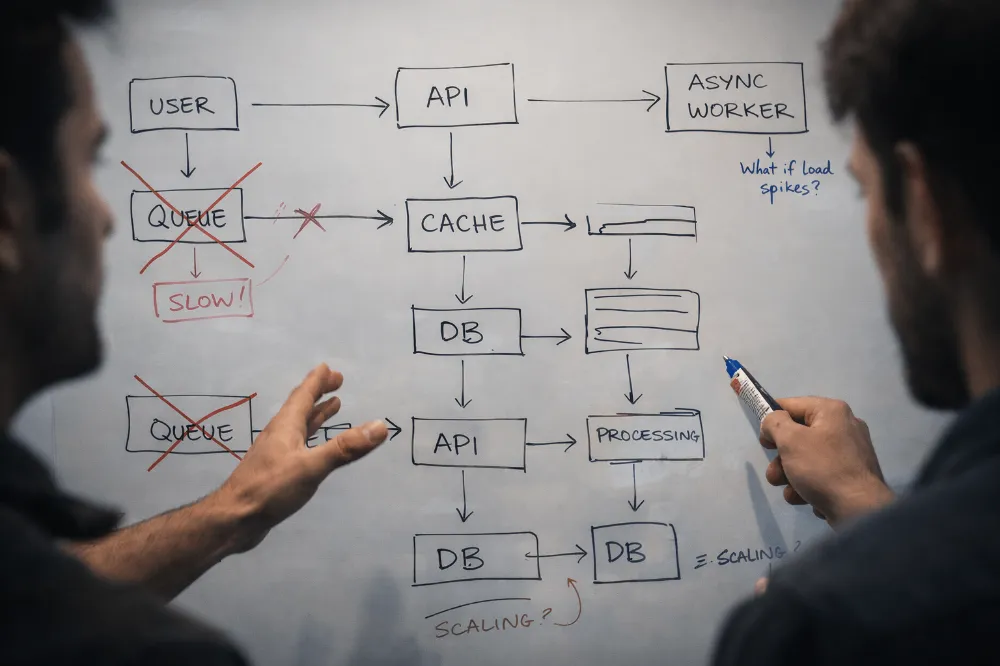
When something breaks badly, no one asks, “Which AI generated this?”
They ask, “Who owns this?”
Ownership is not a feature. It’s a burden. It means being accountable for decisions long after the excitement of building is gone.
AI doesn’t own systems.
Developers do.
And ownership changes how carefully you think.
So What Is AI Really Doing?
AI is not replacing developers. It is replacing repetition.
It removes the boring parts. The mechanical parts. The parts that drained energy without adding insight.
What remains is the hardest part of the job: thinking, designing, choosing, and caring.
Developers who only typed code were always at risk. AI just made that visible.
Developers who think in systems are becoming more powerful than ever.
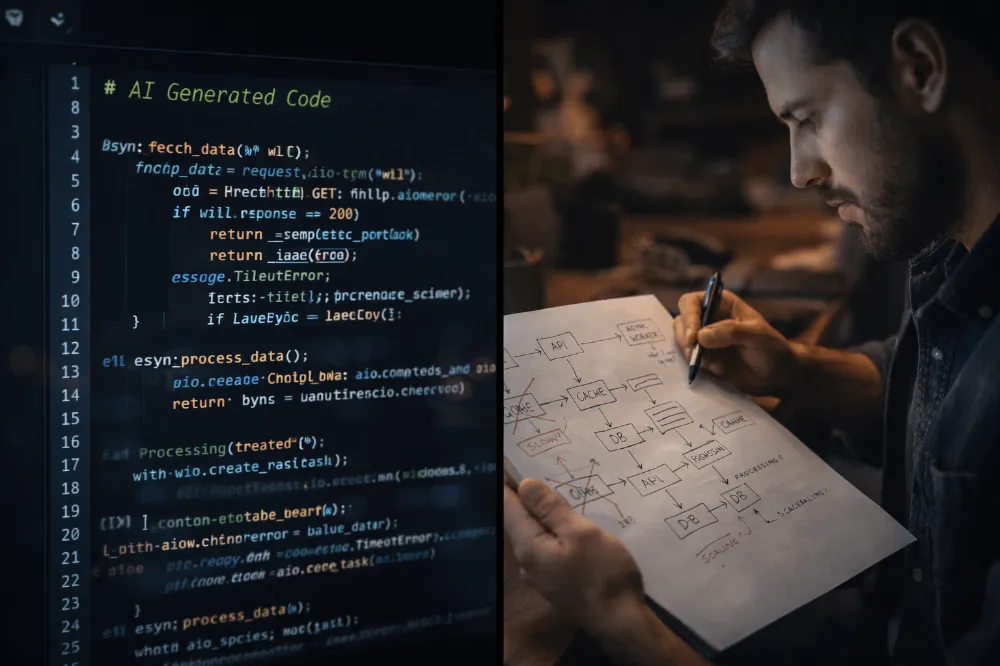
One day, the lights will go out again. Maybe literally. Maybe metaphorically, a system failure, a market shift, a sudden requirement change.
AI will wait.
Developers will think.
They will carry context forward, make imperfect decisions under pressure, and hold fragile systems together with judgment that cannot be automated.
And when everything is back online, AI will return confident, fast and helpful.
But it will still be a tool.
Not the thinker.
AI has tokens.
Developers have context.
AI needs electricity.
Developers need curiosity.
AI generates answers.
Developers live with consequences.
That’s not an insult to AI.
It’s a reminder of what engineering really is.