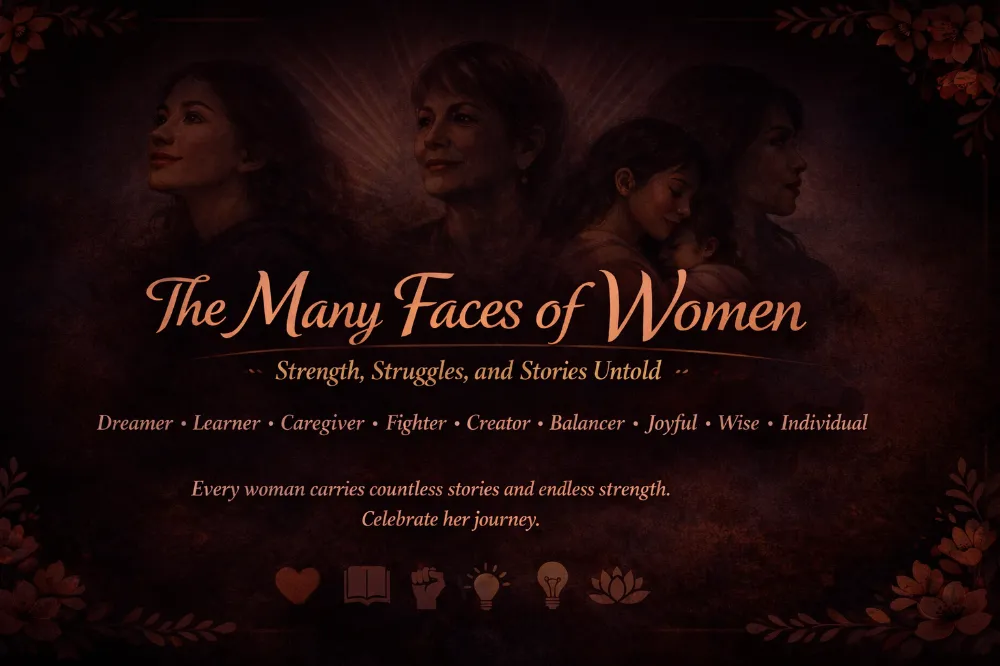
The Many Faces of Women: Strength, Struggles, and Stories Untold.

Different Faces of Women: The Many Lives One Person Lives
It’s strange how often people try to describe women in just one sentence. Caring. Emotional. Strong. Sensitive. Independent. Traditional. Modern. But none of these words alone ever feel enough. Because the truth is, a woman is never just one version of herself. She changes, grows, adjusts, survives, and rebuilds- sometimes all within a single day.
If you really pay attention, you’ll notice that every woman carries many faces. Not fake ones, not masks—just different parts of who she is, shaped by experience, responsibility, love, pressure, and time.
The first face many women carry is that of a dreamer. As children, girls dream freely. They imagine their future without limits. Some want to explore the world, some want meaningful work, some want peaceful homes filled with love, and some want things they don’t even have words for yet. Their dreams are not always practical—but they are honest. And even when life becomes complicated, that dreaming part rarely disappears completely. It just becomes quieter, more careful, and more realistic. But it stays.
Then life begins teaching lessons—and the dreamer slowly becomes a learner. Not just through education, but through living. Women learn how people behave, how expectations work, how to adjust when things don’t go as planned. They learn how to stay calm when things fall apart. They learn when to speak and when silence is safer. Many of these lessons are never written anywhere—they are absorbed through experience. Sometimes through pain. Sometimes through responsibility that arrives too early.
One of the most visible faces of a woman is the caregiver. Society notices this role easily—but rarely understands its weight. Caring is not just cooking meals or helping someone when they are sick. It is constant awareness. It is remembering small details about people. It is noticing mood changes. It is worrying quietly. It is putting someone else’s comfort ahead of your own without even thinking about it.
Care does not follow office hours. It doesn’t end at night. It doesn’t pause when the caregiver feels tired. And yet, many women perform this emotional and physical care so naturally that others assume it is effortless. It is not effortless. It is energy, patience, and love repeated daily.
But women are not only gentle. They are also fighters, though many never call themselves that. Some fight loudly—demanding fairness, respect, and opportunity. Others fight silently—holding their lives together when everything feels unstable. Fighting does not always mean confrontation. Sometimes fighting simply means continuing. Showing up. Trying again. Refusing to collapse even when exhausted.
Some of the hardest battles women face are invisible — fear, self-doubt, and pressure to meet expectations that keep changing. Many learn to stand strong without anyone noticing how much strength it actually takes.
There is also the face of a creator. Creation is not limited to art or invention. Women create spaces where people feel safe. They create routines that keep families functioning. They create solutions when resources are limited. They create emotional stability in moments of chaos. Yes, some create life itself—but creation goes far beyond that. It lives in problem-solving, organizing, imagining, building, and nurturing growth in others.
Many women become natural balancers, often without choosing to be. They handle multiple responsibilities at once—work, home, relationships, expectations, and personal goals. And they move between these roles quickly. One moment making professional decisions, the next offering emotional support, the next managing practical tasks that no one else even noticed needed to be done.
This constant shifting is tiring. But it also shows an extraordinary ability to adapt. Women often learn to carry many roles because life leaves them no other option.
Then there is a face people rarely talk about—the quiet bearer of struggle. Many women carry stress, sadness, or pressure without openly sharing it. They function normally while feeling overwhelmed. They smile while worried. They continue helping others while needing help themselves.
Part of this silence comes from expectation. Society praises “strong women,” but often forgets that strength can be lonely. When people assume you can handle everything, they stop asking how you are really doing.
And still—despite everything—women also carry the face of joy. They laugh deeply. They celebrate small moments. They create warmth in everyday life. A simple meal becomes meaningful because of shared conversation. A festival becomes brighter because of their enthusiasm. A gathering feels complete because they hold emotional connections together.
Joy is not accidental for many women—it is something they intentionally create, even when life feels heavy.
As time passes, another face appears—wisdom. Not the kind that comes from theory, but from lived experience. Women who have navigated years of responsibility, change, and challenge develop a certain steadiness. They understand what truly matters and what doesn’t. They react less impulsively. They observe more. Their advice often comes from memory, not opinion.
Sometimes their wisdom is spoken. Sometimes it is simply demonstrated in the way they handle life.
Yet among all these roles, there is one face that often gets neglected—the face of the individual self. A woman is not only what she gives, fixes, manages, or supports. She is also someone with her own identity beyond responsibilities. She has interests that belong only to her. Thoughts she may never share. Dreams that still quietly exist.
When this personal self is ignored for too long, exhaustion grows. But when it is respected—when she has space to simply be herself—everything else she does becomes lighter.
The truth is, these faces do not appear one at a time. They overlap. A woman can feel strong and tired in the same moment. She can care deeply for others while needing care herself. She can be confident in one area of life and uncertain in another. This is not inconsistency—it is complexity. And complexity is natural.
No two women live the same story. Background, culture, opportunity, and circumstance shape each journey differently. Some paths are supported. Some are difficult. Some are unpredictable. But every path leaves marks—lessons, resilience, perspective.
To understand women fully, we have to stop looking for simple definitions. A single label cannot contain a life that is constantly changing. What we see on the surface is only a small part of what exists underneath—effort, emotion, thought, adjustment, and endurance.
The different faces of women are not roles they perform for the world. They are reflections of everything they have experienced. Every challenge adds depth. Every responsibility adds strength. Every moment—ordinary or significant—shapes who they become.
And perhaps that is the most honest way to understand women: not as one identity, but as many lived realities existing together in one person—growing, shifting, and continuing forward, day after day.