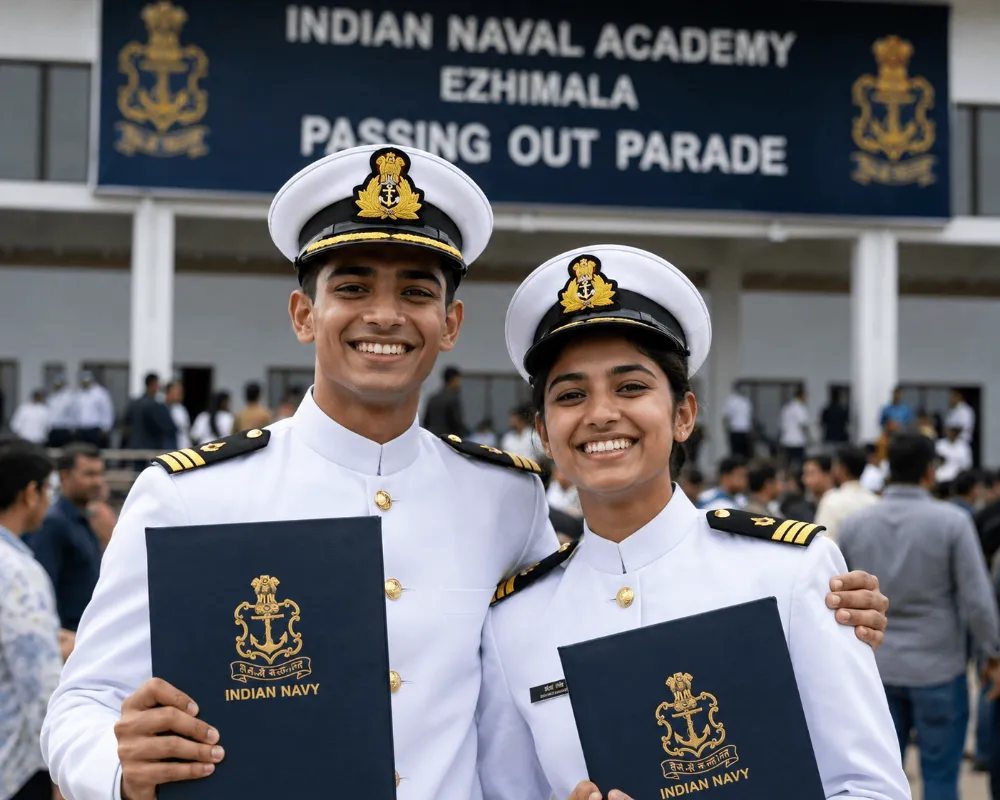
From Equations to Oceans ⚓

The Sea is Calling -
Here's How You Answer It Imagine you are on the deck of a warship, the Indian Ocean in front of you, wind on your face, an officer's rank on your shoulder. Not a fantasy. Not a film. Real life. And it could start with a choice you make today, while you are still in school. If that appeals, this blog is for you. Because the Indian Navy does not wait for you to graduate from college. Its doors are open as early as Class 12, and the way is closer than most assume.
There are two paths. Both are real. Both are worth it. There are two basic ways to gain a commission as an officer in the Indian Navy straight after your 12th boards. The first is through the NDA - the National Defence Academy. The second is the 10+2 B.Tech Cadet Entry. Both require Physics and Mathematics as part of your stream. Both take you to the same place - a commission as an officer. The difference is in the journey.
Path One - The NDA is conducted by the UPSC, which releases two notifications every year - NDA-I and NDA-II - with exam cycles approximately in April and September. The written exam consists of two papers: Mathematics and a General Ability Test, which covers English, Physics, Chemistry, General Knowledge, History, and Geography, at the 10+2 level. If you pass the written exam you are called for the SSB - the Services Selection Board - which is a five-day selection process comprising psychological tests, group tasks, outdoor activities, personal interviews, and a final conference. Clear that, pass the medical, and you go to the National Defence Academy in Khadakwasla for three years of joint training with future Army and Air Force officers. After that comes specialized naval training at the Indian Naval Academy in Ezhimala, Kerala. You graduate commissioned as a Sub-Lieutenant. To be eligible for this route you need to be around 16.5 to 19.5 years old. You should have Physics and Mathematics in 10+2, or be appearing in your boards when you apply. You must be unmarried and an Indian citizen. Exact age cut-offs and percentage requirements change with each notification, so always check the official UPSC notice.
Path Two - The 10+2 B.Tech Cadet Entry The second path is designed for those who are strong in science and engineering. Shortlisting is based on your JEE Main All India Rank, after which selected candidates undergo the SSB and a medical examination. Those who qualify enroll at the Indian Naval Academy in Ezhimala for a four-year B.Tech program. Complete the course and you will have both an approved engineering degree and a commission as an officer in the Indian Navy. The age range here is roughly 17 to 21 years. The conditions are similar - Physics and Mathematics in 10+2, unmarried, Indian citizen - and a competitive JEE Main rank is the real factor. Notices follow the JEE Main schedule and Indian Navy publications, so stay informed. What the SSB Tests Anymore Both paths involve the SSB, and this is where many aspirants get concerned. It's a natural feeling. Five days of tests does seem like a lot. But the SSB is not meant to scare you or trap you. It is meant to discover who you truly are - how you handle stress, how you cooperate with others, whether you can take charge in a challenging situation. And the good news is that you can develop these qualities. Joining a debate team, participating in team sports, volunteering for responsibilities at school, practicing effective communication - all of it helps. You don't need to be a superhuman or a genius. You need to be authentic, relaxed, and eager to improve. Work on those areas now, and the SSB becomes less intimidating. Salary and What you earn as an Officer This is an aspect often overlooked by many blogs, and it shouldn't be. A career in the Indian Navy is financially sound, steady, and comes with perks that few civilian jobs can offer at a similar age. As a newly commissioned Sub-Lieutenant, your gross monthly salary is about Rs. 56,100 as basic pay under Level 10 of the 7th Pay Commission, with Military Service Pay of Rs. 15,500 included. With allowances such as Transport Allowance, Dearness Allowance, and kit maintenance your take-home pay generally varies between Rs. 80,000 and Rs. 1,00,000 a month, depending on your location and posting. Beyond this, the benefits are significant. Subsidised housing on naval bases, free health care for you and your family, Leave Travel Concession, canteen privileges, children’s education allowances, and a generous pension scheme. Officers on sea duty also get Sea Duty Allowance, which adds considerably to the monthly figure. As you progress through the ranks - from Sub-Lieutenant to Lieutenant, Lieutenant Commander, Commander, and beyond - the pay and responsibilities increase proportionally. This is not just a career. It is a financially secure, fully supported lifestyle, and it begins at an age when many of your classmates are still seeking their first internship.
The Medical - Do not ignore it . The medical exam is where many prepared candidates falter, not because they are unhealthy, but because they did not confirm their status against the Navy's exact standards early enough. Requirements include eyesight, hearing, height and weight ratios, and overall physical health. These are stringent and non-negotiable. If you pass the written exam and the SSB but do not meet the medical criteria, you are disqualified - and that really is a setback after such dedication. The simple advice is to get a preliminary check done now, against the medical standards listed in the current official notice. If something is amiss, you have time to correct it. This step alone has spared many aspirants from heartbreak.What to Concentrate on Right Now If you are in Class 11 or 12 and you are taking this seriously, here is where you should devote your efforts. Academically, if you are going the NDA path, practice the NDA Mathematics syllabus and the GAT consistently. Both are doable with a dedicated preparation schedule. If the B.Tech cadet route is for you, your JEE Main rank is what makes the difference - give that the same attention you would any top engineering entrance. Physically, begin now. Running, push-ups, pull-ups, core strengthening - develop these routines over time, not weeks. Physical fitness can't be hurried, and it will be valuable long after selection. For documentation, keep your 10th and 12th mark sheets, date of birth certificate, domicile proof, ID proofs, JEE scorecard if relevant, and recent photographs - originals and photocopies - organized and accessible. And for info, consult directly with the sources. Regularly visit the UPSC website and the official Indian Navy portal. Each notification lists specific data - age limits, percentage cut-offs, medical criteria, application periods .