WHAT THE HUNGER KNOWS

I. Before
I used to think I was a simple woman.
Not simple in the way people mean when they’re being polite about someone, not dull, not unremarkable — but simple in appetite. I wanted what I could name. A good job. A clean apartment. A man who didn’t make everything complicated. I had all three by the time I was thirty-one, and I wore the satisfaction of it like something tailored, fitted perfectly to the shape of my ambitions. And I loved that man more than anything i ever did before .
Then Roan cooked for me, and I discovered that I had never, not once in my life, been hungry before. It happened on a rainy Tuesday. I came home to a smell that stopped me at the threshold the way a hand pressed flat against a chest stops a person — “What is this smell”. Dark and deep and threaded through with something I couldn’t locate in any memory I owned. Roan was at the stove with his back to me, moving the way he always moved: without waste, without theater, as though everything he did had been decided far in advance and the execution was simply a formality.
He turned. He smiled.
“Sit,” he said.
I sat.
The first bite reached inside me and rearranged something. I don’t know how else to describe it. Not pleasure — pleasure was too small a word, too thin, too mapped. This was recognition. As though my body had been waiting for a particular thing its entire life without knowing what the thing was, and had just been handed it without ceremony. I cleaned the plate. I looked at the plate. I looked at Roan. That night I lay beside him in the dark and stared at the ceiling and thought: I would like to feel that again.
I had no idea what I was beginning.
II. The Craving
By the third week, I had stopped pretending the feeling was normal.
Nine o’clock was its hour. I know that sounds precise, and it was — unsettlingly, almost mechanically precise. Sometime in the fifty-ninth minute of eight, a change would begin in my jaw. Not pain. Closer to pressure, a low persistent pull that moved outward through my throat and chest until the whole of my attention collapsed inward to a single, burning point. The kitchen. The smell gathering on the stove. Roan’s hands.
I would sit at the counter and watch him cook with a quality of focus I had never applied to anything in my professional life, any relationship, any desire I’d ever charted and pursued. Pure and blank and total. My colleagues at the office had begun remarking on my distraction. My friend Mary texted asking if everything was all right. I told her yes, and meant it, and could not have explained that yes to her even if I’d tried.
After dinner, I would ask him.
“The ingredient,” I said, one night in December, setting my fork across the empty plate with the deliberate care of someone setting down something important. “I need to know what it is.”
“Good technique,” he said. He refilled my glass.
“Roan.” I moved the glass aside. “I sat in four meetings today and I have no memory of any of them. I drove home and I cannot tell you a single street I used. This — “ I pressed two fingers to the center of my sternum — “this is the only thing that feels real to me anymore. You need to tell me what you’re putting in it.”
He looked at me for a long time. There was something in his face I had learned to read in our months together — that careful, internal calibration of his, the weighing of what the room could bear. It lived behind his eyes, quietly, like a pilot light.
“You really want to know,” he said.
I held his gaze and said nothing. Roan respected silence more than insistence; I had learned that early.
He set down the bottle.
He told me.
III. The Revelation
Human meat.
I heard the words. I turned them over in my mind with the distant, clinical interest of someone handling an object they haven’t identified yet. I watched his face for the flinch of a joke landing, for any soft edge of performance. I found nothing. His eyes were steady and deeply tired and entirely serious, and his hands on the table were still.
I stood up. I put on my jacket. I left.
I walked eleven blocks to Mary’s apartment in the cold, operating my body from somewhere behind my own eyes. She opened the door and her face did the thing faces do when they recognize that something has happened, and she poured wine and asked nothing and sat beside me, and I was grateful for her in a hollow, distant way.
I lay in her spare room until three in the morning. I catalogued my feelings with the same precision I applied to quarterly reviews and difficult contracts, because that is how I have always managed what I cannot immediately resolve.
First: revulsion. Loud, immediate, sincere.
Then: a confused and searching grief — for what exactly, I wasn’t certain.
Then, quieter than either, arriving on soft feet below the others:
The memory of the taste.
I pressed my tongue to the roof of my mouth. I felt the phantom of it — that depth, that intimacy, that sense of something recognized below language. My jaw began, very faintly, to ache.
Stop, I told myself.
I stopped it.
I was very disciplined. I had always been very disciplined.
By nine o’clock the following evening I was putting on my shoes.
IV. The Return
Mary appeared in the hallway, alarmed.
I told her I needed to talk to Roan. She said my name in the particular way she used when she was worried and not yet ready to push, and I looked at her — warm, careful, uncomplicated Mary — and felt the distance between us as something newly vast.
She could not understand what I was walking back to. But she also could not understand what I was walking back from — the spare room, the ceiling, the grinding discipline of holding myself still while my body itemized its wants with increasing specificity.
I ran the eleven blocks. I didn’t decide to run; my legs decided.
He was in the kitchen. The smell reached me through the door.
I went inside and sat across from him and said: “Tell me everything. Who. How. Why. I am not leaving until I understand all of it.”
He told me.
The men were not chosen arbitrarily — I want to be clear that I understood this immediately, and that it mattered to me, and that I am also aware the clarity with which I understood it might itself be a symptom of something I was no longer in a position to diagnose. Convicted men. Documented men. Men the system had processed and released back into ordinary life carrying what they’d done like a credential. RApists .Roan had watched systems fail with the exhausted precision of someone who had staked his faith in them once and could not afford to again. His PTSD had given him impulses, his therapist had told him. He had decided the impulses were information
“And the rest,” he said, “I do not waste.”
I sat with this. A long moment, the apartment quiet around us, the city beyond the window enormous and entirely unaware.
I thought about the taste. I thought about the nine-o’clock gravity of it, the way it had reorganized my days around itself without asking permission. I thought about what it meant that my body had known before my mind was told — had recognized something ancient and particular and had wanted more of it with a consistency that no argument, no moral inventory, no eleven blocks in the cold had been able to interrupt.
I thought: he is not wrong about the men.
And then, quieter, below that:
I would not have it stop.
“Show me how to cook it,” I said. “I want to learn.”
V. The Apprenticeship
I was a good student. Better than good — I was precise in the way that frightened Roan a little, though he would not have said so. He taught with patience, with the methodical grace of someone whose knowledge has moved past technique into instinct, and I absorbed it with an attention I had never given anything before.
Temperature. Rest. The acid that opened flavor, the fat that carried it. The specific geography of a cut and what it would yield and why. I learned to move through the work without flinching, without sentiment, with the focused calm of someone who has accepted what they are doing and found the acceptance clarifying rather than disturbing.
What disturbed me — in the private ledger I kept and showed no one — was how quickly the clarification came.
Roan’s rationale was moral. I understood this. He killed to control an impulse that would otherwise control him, and he directed that impulse at men the world had already marked and found wanting. It was — within its own logic, which I had stepped into the way you step into a warm room on a cold night and let the door close behind you — coherent. Even principled.
My rationale, I began to notice, was quieter than his. Less articulated.
I cooked because I wanted to. Because the want was enormous and specific and mine, and it asked no further justification from me than the nine-o’clock ache that arrived daily with the reliability of a tide. I cooked and I sat across from Roan in the kitchen light and I ate and felt the flavor move through me, and something that had always been restless in my chest went still.
I wondered, sometimes, sitting there in the particular quiet that follows a good meal, what that said about me relative to Roan. He required a reason. A moral framework elaborate enough to support the weight of what he did.
I required the taste.
I found myself thinking this was the more honest arrangement of the two.
VI. The Wine
The blood was my idea. I want to own that.
It was an accident at first , a cut, a reflex, the instinctive gesture of raising my hand to my mouth before I’d chosen to. What I found there was sharper than anything the heat had given me. Immediate and alive and copper-bright, a version of the depth I’d been chasing since November, stripped of all intermediary process.
I thought about it for three days before I did anything.
Then I began saving it. Carefully, in the dark glass of emptied wine bottles, sealed with the same corks, labeled in my handwriting and placed in the back of the rack where the light didn’t reach. I told myself it was for the evenings when dinner wasn’t ready and the craving arrived early and there was nothing else. I told myself it was practical.
I knew it was not practical. I knew it was something that had no name I was willing to apply to it yet, and that the absence of a name was not the absence of a thing.
Roan found one on a Wednesday evening. He lifted it from the rack, uncorked it, recognized immediately what it was. He looked at me across the kitchen.
I met his eyes and waited.
He corked it. Replaced it. Said nothing.
That was the moment I understood something about us — something that had perhaps always been true but now had weight, now had shape. Roan was the architect of this life. He had built its moral structure, its logic, its limits. He had designed the rooms.
But I was no longer a guest in them.
I had begun, quietly, to build my own.
But one thing did not change , the love, his love for me and mine for him . The quiet silent ways he still notices about me , I LOVE HIM.
VII. After
Spring came. The city outside the windows continued at its enormous, indifferent pace, full of its own appetites and ignorances, moving through its days with the confidence of something that does not know it is being watched.
I still went to work. I still met Mary for lunch every other Friday, and she still did not ask the question she had chosen not to ask in that hallway in December, and I was grateful to her for this in a way I could not fully examine without arriving at something uncomfortable about what my gratitude contained.
Roan still attended his appointments. Still maintained the quiet, unremarkable surface of a retired man in a city apartment. He was good at surfaces. He had been trained to maintain them under conditions far worse than ordinary life, and ordinary life asked very little of him in comparison.
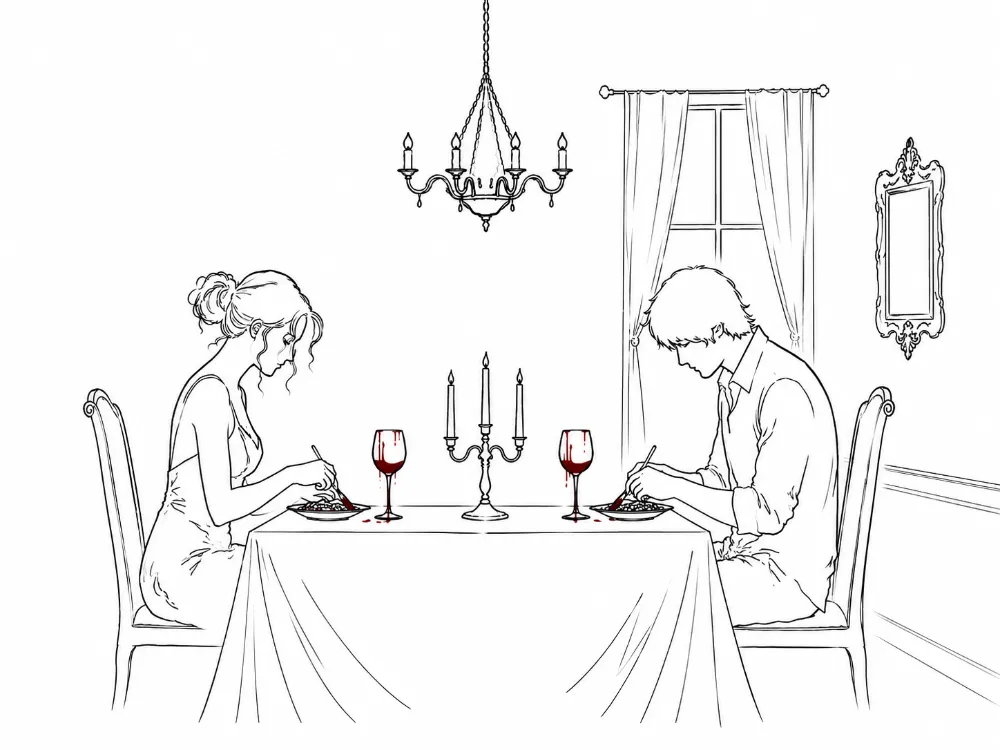
And every evening, close to nine, the smell of something dark and deep and singular gathered in the apartment, and I came to the kitchen, and Roan filled my glass, and we sat together in the particular peace of two people who are no longer keeping anything from one another.
I used to think I was a simple woman.
I know better now. I know that what I am is patient. And precise. And capable of a quality of want that does not negotiate with itself, does not require justification, does not soften at the edges when it meets something difficult.
Roan kills for reasons. He has always needed them — the moral ledger, the careful accounting of who deserves what, the structure that holds the impulse in a shape he can look at.
I am beginning to think I will not always need the same reasons he does.
I think about this sometimes, in the quiet after dinner, while he clears the table and I sit with my glass — the dark, sealed bottle from the back of the rack, the one he found and replaced without a word. I turn the thought over without anxiety, the way you turn a stone in your hand: curious, unhurried, noting its weight.
It is a new thought. A young thought.
I am in no rush.
Outside, the city hums. Inside, the wine is very dark, and dinner is always at nine, and Charlie Donnaway sits at her table and thinks about how quiet the hunger is now. How patient. How perfectly, terrifyingly at home.